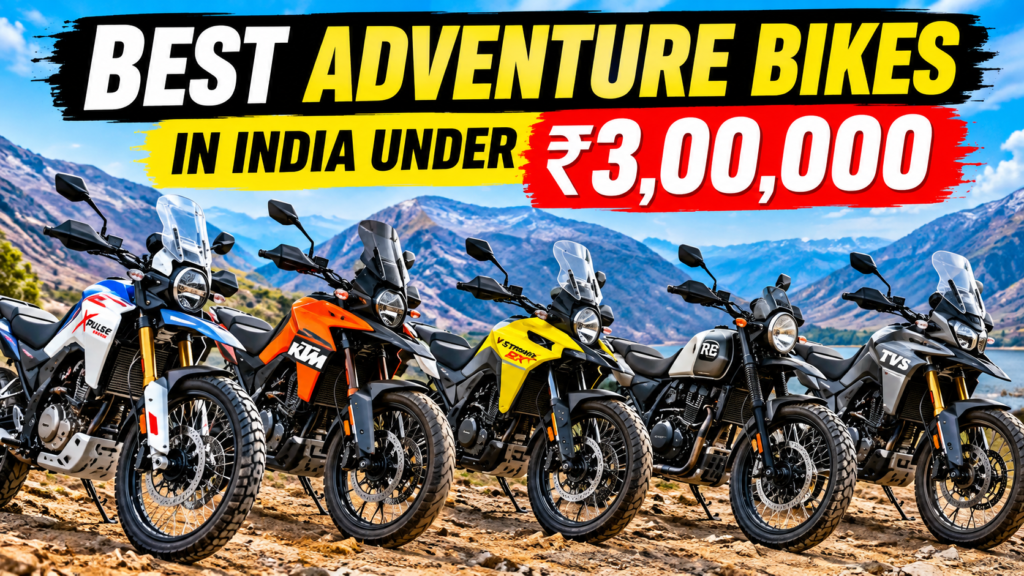
If you are searching for an adventure bike in India under ₹3,00,000, you are entering one of the most interesting parts of the Indian motorcycle market. Adventure motorcycles are no longer limited to expensive premium machines designed only for serious touring enthusiasts. Today, riders can choose from several motorcycles that combine upright ergonomics, long-travel suspension, useful ground clearance, touring capability and reasonable running costs without crossing the ₹3 lakh budget. Depending on your riding style, the right motorcycle could be a lightweight machine such as the Hero XPulse 210, a road-focused adventure tourer such as the Suzuki V-Strom SX, a performance-oriented KTM 250 Adventure, or a crossover such as the Royal Enfield Scram 440. Current market listings also show several adventure-oriented motorcycles available below or around this price point, making the segment highly competitive.
The important thing is to understand that ₹3 lakh is not the same as ₹3 lakh on-road. Most manufacturers advertise ex-showroom prices, while registration, insurance, road tax, handling-related charges where applicable, accessories and other costs can increase the final amount. For example, Hero’s current Agra listing puts the XPulse 210 between ₹1,66,745 and ₹1,75,963 ex-showroom, while KTM lists the 250 Adventure at ₹2,40,010 ex-showroom in Delhi. Suzuki’s V-Strom SX is listed at ₹1,98,018 ex-showroom Delhi. These figures leave different amounts available for insurance and accessories, so your city and exact variant matter when calculating your actual purchase budget.
Why Adventure Bikes Are Popular in India
Adventure motorcycles make sense in India because our roads can change dramatically within a single journey. You might start your morning on a smooth city road, spend the afternoon on a highway and finish the day on broken pavement, gravel, mud or a steep mountain road. A conventional street motorcycle can handle many of these situations, but an adventure-oriented motorcycle is designed around versatility. Its upright riding position gives the rider a commanding view, while suspension travel and ground clearance help when the surface becomes uneven. That combination is particularly useful for riders who want one motorcycle instead of maintaining separate bikes for commuting and touring.
The popularity of adventure motorcycles is also connected to the growth of motorcycle touring. Riders increasingly plan trips to places such as Ladakh, Spiti, Uttarakhand, Rajasthan, Northeast India and the Western Ghats. These journeys require more than straight-line performance. Fuel range, comfort, luggage capacity, suspension behaviour, tyre choice and reliability can become more important than a high top speed. This is why motorcycles such as the XPulse 210, KTM 250 Adventure, V-Strom SX and Scram 440 appeal to different kinds of riders. They approach adventure riding from different directions, so the best choice depends less on the badge and more on how you actually intend to use the bike.
What Makes an Adventure Motorcycle Different
An adventure motorcycle generally combines characteristics that are useful on both paved and unpaved roads. The riding position is usually upright, allowing the rider to remain comfortable over long distances while also providing better control on uneven surfaces. Many adventure bikes use relatively tall suspension setups and substantial ground clearance, reducing the chance of the engine or chassis hitting obstacles. Wheel sizes can also influence handling, particularly when riding over loose surfaces, potholes and rough terrain. Modern machines may add ride modes, traction control, switchable ABS, navigation connectivity, TFT displays and other electronic systems.
However, more features do not automatically mean a motorcycle is better for every rider. A tall motorcycle can feel intimidating in traffic, especially for a shorter rider. A large engine can be enjoyable on highways but may add weight and fuel expense in everyday commuting. A highly off-road-focused motorcycle may sacrifice some highway comfort, while a road-biased adventure tourer may not be ideal for aggressive trail riding. This is why choosing an adventure bike should start with your typical journey rather than the specification sheet. Think about where you will ride 80% of the time, then make sure the motorcycle can comfortably handle the remaining 20%.
Best Adventure Bikes Under ₹3 Lakh in 2026
The under-₹3-lakh adventure category has several interesting choices. The Hero XPulse 210 is positioned as an accessible adventure motorcycle with strong emphasis on versatility and value. KTM’s 250 Adventure brings a more performance-focused character, while Suzuki’s V-Strom SX targets riders who want a comfortable adventure-styled touring machine with a relatively compact engine. Royal Enfield’s Scram 440 occupies an interesting middle ground because it is an ADV crossover rather than a traditional tall adventure motorcycle. TVS has also entered the conversation with the Apache RTX 300, which adds another option for buyers looking for a modern adventure-oriented motorcycle.
Current market data places the XPulse 210 around ₹1.67 lakh, the KTM 250 Adventure around ₹2.40 lakh, the Suzuki V-Strom SX around ₹1.98 lakh and the Scram 440 around ₹2.24 lakh, although exact prices vary with location, variant and manufacturer updates. These numbers should be treated as current reference prices rather than final on-road quotes. Before purchasing, always obtain a written quotation from the local dealership. A motorcycle that appears comfortably below ₹3 lakh ex-showroom may approach or exceed that amount after registration, insurance and accessories.
Hero XPulse 210
The Hero XPulse 210 is one of the most accessible choices for someone searching for an adventure bike under ₹3 lakh. Hero’s current Agra listing shows the motorcycle from ₹1,66,745 ex-showroom, with the top variant listed at ₹1,75,963. That leaves considerable room within a ₹3 lakh budget for riding gear, luggage, crash protection and other touring equipment. The motorcycle’s relatively manageable positioning makes it attractive to riders who want a motorcycle that can be used for daily commuting while still offering adventure-bike characteristics.
The XPulse 210 is powered by a 210cc engine and is built around a lightweight adventure concept. Current market data lists approximately 24.5 PS and mileage around 40 km/l, although real-world fuel consumption will depend heavily on riding style, traffic, load and terrain. For a rider who spends weekdays commuting and weekends exploring broken roads or trails, that balance can be useful. Its price also makes it easier to justify spending money on essential accessories such as a bash plate, handguards, luggage, auxiliary protection and quality riding equipment. The most important advantage here is not simply the low purchase price; it is the possibility of building a complete touring setup without immediately exhausting the motorcycle budget.
KTM 250 Adventure
The KTM 250 Adventure is aimed at riders who want more performance and modern electronics while staying below the ₹3 lakh ex-showroom threshold. KTM’s official listing gives the motorcycle a 249.07cc engine producing 31 PS and 25 Nm, along with a 19-inch front and 17-inch rear wheel combination. The manufacturer also lists WP APEX suspension with 200 mm travel, a TFT display, KTMconnect, cornering traction control, ABS and an off-road mode. Its current listed ex-showroom Delhi price is ₹2,40,010.
That specification makes the KTM particularly interesting for riders who expect a mixture of highways, twisty roads and moderate off-road use. The engine provides more performance than many entry-level adventure motorcycles, while the chassis and electronics are designed around adventure touring. The trade-off is that the motorcycle consumes a larger portion of a ₹3 lakh budget before on-road expenses are added. Buyers should therefore calculate the complete purchase price instead of assuming the advertised ex-showroom number is their final expense. If you also need panniers, luggage, riding gear and protection accessories, the overall project can become significantly more expensive.
Suzuki V-Strom SX
The Suzuki V-Strom SX takes a slightly different approach to adventure riding. Instead of concentrating heavily on difficult off-road terrain, it is designed as an adventure-styled motorcycle that works particularly well for touring and mixed everyday use. Suzuki currently lists the V-Strom SX at ₹1,98,018 ex-showroom Delhi, while its 249cc engine produces 26.5 PS and 22.2 Nm according to Suzuki’s current media information. The motorcycle uses Suzuki’s oil-cooled single-cylinder engine technology and is designed to balance performance with efficiency.
For someone who spends a lot of time on highways and city roads but occasionally rides through rough surfaces, the V-Strom SX can make considerable sense. Its adventure ergonomics provide a relaxed riding position, while the compact engine keeps the motorcycle relatively approachable. Suzuki also highlights fuel efficiency and practical touring characteristics, which are important when planning long-distance journeys. Riders should remember, however, that an adventure-styled motorcycle is not automatically a dedicated off-road machine. If your weekends involve difficult trails, deep mud and technical terrain, suspension, tyre selection and overall chassis design deserve more attention than styling alone.
Royal Enfield Scram 440
The Royal Enfield Scram 440 is an interesting option for riders who want a crossover motorcycle rather than a tall, traditional ADV. Royal Enfield describes it as an ADV crossover engineered for urban use and off-road capability. Its 443cc long-stroke engine produces 25.4 bhp and 34 Nm according to the manufacturer’s current product page, while the motorcycle uses a six-speed gearbox, alloy wheels and tubeless tyres. Royal Enfield’s current support information lists the Scram 440 from ₹2.24 lakh in India, while its original launch price was ₹2.08 lakh ex-showroom Chennai.
The Scram 440’s character makes it appealing to riders who like relaxed torque delivery and a more approachable crossover format. Its 795 mm seat height can also make it easier for some riders to manage compared with taller adventure motorcycles. The motorcycle is not trying to be an extreme enduro machine; instead, it aims to combine everyday usability with touring and light-to-moderate off-road ability. That makes it particularly interesting for riders who want a motorcycle capable of travelling across varied Indian roads without feeling excessively specialised. As always, the final price should be checked with a dealer because taxes, insurance and other charges vary by location.
TVS Apache RTX 300
The TVS Apache RTX 300 is another motorcycle worth considering in the modern Indian adventure-bike conversation. Current market listings place it around the ₹2-lakh range, putting it comfortably within the broader ₹3 lakh budget. Its positioning is particularly interesting because TVS is targeting riders who want a contemporary adventure-tourer package rather than simply converting a conventional street motorcycle into an adventure-styled product. The RTX 300 brings a combination of touring ergonomics, modern equipment and an engine size suited to riders who want more performance than small-capacity commuters.
For buyers, the RTX 300’s biggest attraction is the way it expands the choices available in this price bracket. Instead of choosing only between established models, customers can now consider newer platforms and compare them based on engine behaviour, suspension setup, electronics, service reach and practical usability. Since pricing and variant availability can change, buyers should check the latest official quotation before treating any online figure as final. The same rule applies to every motorcycle in this article: the best adventure bike is the one whose complete ownership package fits your riding needs and budget, not simply the one with the longest feature list.
Adventure Bike Price Comparison
Price is one of the first things buyers compare, but it should not be the only measurement. A motorcycle costing ₹1.7 lakh ex-showroom may look dramatically cheaper than a motorcycle costing ₹2.4 lakh, yet the difference can be spent on accessories, luggage and riding equipment that are essential for touring. On the other hand, spending the entire budget on the motorcycle can leave you without enough money for a good helmet, riding jacket, boots, gloves and protective accessories. A sensible adventure-bike budget therefore includes the complete ownership package rather than only the showroom price.
| Adventure Bike | Approx. Current Ex-Showroom Reference | Engine | Character |
|---|---|---|---|
| Hero XPulse 210 | ₹1.67–1.76 lakh | 210cc | Adventure/off-road focused |
| Suzuki V-Strom SX | ₹1.98 lakh | 249cc | Touring and mixed roads |
| Royal Enfield Scram 440 | ₹2.24 lakh | 443cc | Crossover/touring |
| KTM 250 Adventure | ₹2.40 lakh | 249cc | Performance adventure |
| TVS Apache RTX 300 | Around ₹2 lakh | 299cc | Modern adventure touring |
Prices are indicative current references and can vary by city, variant, insurance and other charges. Hero’s Agra listing, Suzuki’s Delhi pricing, KTM’s Delhi listing and Royal Enfield’s current information were used as reference points.
Engine and Performance Comparison
Engine capacity tells only part of the story. The XPulse 210 is designed around accessible adventure performance, while the KTM 250 Adventure produces a stronger 31 PS and 25 Nm from its 249.07cc engine. Suzuki’s V-Strom SX produces 26.5 PS and 22.2 Nm, focusing on balanced road performance, whereas the Scram 440 uses a larger 443cc long-stroke engine with 25.4 bhp and 34 Nm. These different approaches demonstrate why riders should test motorcycles rather than choosing purely by displacement. A larger engine does not automatically deliver a better experience, especially if the rider values low-speed control, manageable weight or fuel economy.
Performance should also be considered in the context of Indian roads. A motorcycle with strong mid-range torque may feel more useful during overtaking and climbing than one that makes impressive peak power only at high engine speeds. Similarly, a lightweight motorcycle can be easier to handle when turning around on a narrow mountain road or picking a line through a rough trail. The ideal engine depends on whether your priority is highway cruising, city commuting, mountain touring or technical off-road riding. The numbers are useful for creating a shortlist, but the test ride is where those numbers become real.
Best Adventure Bike for Long Distance Touring
Long-distance touring demands a different set of qualities from pure off-road riding. When you spend six or eight hours on a motorcycle, seat comfort, wind protection, riding posture, vibration, fuel range and luggage options become extremely important. The motorcycle should also remain stable at highway speeds while providing enough suspension capability for broken roads. This is where adventure-tourer designs can be particularly useful because they are generally built around an upright posture and practical long-distance ergonomics.
Among the motorcycles discussed here, the KTM 250 Adventure, Suzuki V-Strom SX and Royal Enfield Scram 440 represent different interpretations of touring. The KTM combines performance and electronic assistance, Suzuki focuses on a balanced touring package, and the Scram 440 provides a torque-rich crossover character. The XPulse 210 can also be a strong touring companion for riders who value lighter weight and rough-road capability. Your typical speed, luggage requirements and passenger use should determine the choice. If your trips regularly include highways followed by mountain roads, evaluate wind protection and luggage mounting just as carefully as engine performance.
Best Adventure Bike for Off-Road Riding
Off-road riding changes the priorities dramatically. Once the road disappears, weight, suspension travel, ground clearance, wheel sizes, tyres and low-speed control become more important than top speed. A motorcycle that feels excellent on a highway can become difficult on a rocky trail if it is too heavy or its tyres are poorly suited to loose terrain. This is why riders planning serious trail riding should look beyond attractive adventure styling and examine the actual hardware.
The XPulse 210 is particularly relevant for riders who want a more accessible adventure machine with off-road intent. The KTM 250 Adventure also provides meaningful adventure equipment, including 19/17-inch wheels, 200 mm suspension travel and an off-road mode. Suzuki’s V-Strom SX is more appropriate for mixed roads and touring than extreme trail work, while the Scram 440 sits in the crossover category. The key lesson is simple: off-road capability is a system, not a single feature. Suspension, tyres, chassis balance, rider skill and motorcycle weight all work together.
Best Adventure Bike for Beginners
A beginner should not automatically buy the most powerful motorcycle available within the budget. Learning to control a motorcycle on gravel, steep slopes, loose soil and tight turns requires confidence, and excessive weight or height can make that learning process harder. A motorcycle that feels manageable at low speed can actually provide more usable adventure performance than a larger motorcycle that intimidates the rider. This is particularly important when travelling alone because picking up a fallen motorcycle can become a genuine challenge.
The XPulse 210 is worth considering for new adventure riders because of its accessible positioning and relatively affordable price. The Suzuki V-Strom SX can also suit riders who primarily travel on roads and want adventure ergonomics without moving into a very large motorcycle. The KTM 250 Adventure provides more performance and technology, but beginners should spend time learning its controls and electronic systems before heading into demanding terrain. Regardless of the motorcycle, a proper riding course, quality protective equipment and gradual progression are more valuable than simply buying an expensive machine.
Important Features to Check Before Buying
When comparing an adventure bike, create a checklist before visiting the showroom. Start with the riding position and seat height because you need to feel comfortable putting your feet down during low-speed manoeuvres. Then examine suspension travel, wheel sizes, tyre availability and ground clearance if rough roads are part of your plan. After that, look at electronics such as ABS modes, traction control, ride modes, navigation and connectivity, but consider whether you will actually use them.
Practicality deserves equal attention. Check whether the manufacturer offers official luggage, crash protection, sump protection, handguards and touring accessories. Ask about service intervals and the approximate cost of regular maintenance. Find out whether replacement tyres and common parts are readily available in the areas where you plan to travel. Finally, inspect the motorcycle’s fuel tank size and expected range because remote touring can make fuel availability an important consideration. A motorcycle may have an excellent specification sheet, but if essential parts are difficult to find during a trip, ownership can become frustrating.
Mileage and Running Costs
Fuel economy is one of the most important considerations for an adventure motorcycle because touring can involve thousands of kilometres. A difference of several kilometres per litre may appear small during a weekend ride, but it becomes meaningful during a 5,000-kilometre trip. Your actual mileage will depend on speed, traffic, tyre pressure, rider weight, luggage, passenger load, road gradient and riding style. Manufacturer or third-party mileage figures should therefore be treated as reference points rather than guarantees.
The cheaper motorcycle is not always the cheapest to operate. Tyre prices, chain and sprocket replacement, brake components, engine oil, insurance and accessories all contribute to ownership costs. A performance-oriented motorcycle may require more expensive components, while a simpler motorcycle may be cheaper to maintain. Before buying, estimate your annual kilometres and create a simple ownership budget. If you ride 15,000 to 20,000 kilometres every year, fuel and maintenance can become more important than a small difference in the initial purchase price.
Maintenance and Service Considerations
Adventure motorcycles often travel farther from home than ordinary commuter motorcycles, so serviceability matters. Before purchasing, check how many authorised service centres are available around your city and along the routes you commonly travel. A motorcycle from a manufacturer with a strong dealership network can be easier to maintain during long trips. You should also ask the dealer about scheduled service intervals, consumable costs, warranty conditions and roadside assistance.
Routine maintenance should not be ignored simply because a motorcycle is designed for adventure riding. After a muddy or dusty trip, the chain, air filter, brakes and cooling system may need extra attention. Regularly checking tyre pressure, spoke or wheel condition where applicable, engine oil, brake pads and fasteners can prevent small problems from becoming major ones. Adventure riding also puts more stress on components when the motorcycle is loaded with luggage. Good maintenance is therefore not merely about saving money; it is part of preparing the motorcycle for safe and reliable travel.
Which Bike Is Suitable for Highways and City Riding
If your motorcycle will spend most of its life in the city, practicality should receive significant weight in your decision. A tall adventure motorcycle can provide excellent visibility but may be less convenient in crowded parking areas and heavy traffic. A lighter motorcycle can be easier to manoeuvre between cars, while a smoother engine may reduce fatigue during daily commuting. Fuel efficiency also becomes more important if you ride every day.
For riders who combine city use with frequent highway trips, the Suzuki V-Strom SX and Royal Enfield Scram 440 represent interesting crossover approaches. The XPulse 210 is attractive for riders who also want to explore rough roads, while the KTM 250 Adventure is aimed more strongly at riders who want performance and adventure equipment. There is no single motorcycle that dominates every environment. The correct choice depends on the percentage of city, highway and off-road riding you expect to do.
How to Choose the Right Adventure Bike
Start by writing down your actual riding pattern. If you commute five days a week and tour once every few months, do not choose a motorcycle solely because it looks ready for the Himalayas. If you regularly travel long distances and ride through broken mountain roads, give more importance to suspension, comfort, fuel range and luggage compatibility. If you are passionate about off-road riding, investigate wheel sizes, tyres, suspension, ground clearance and weight before considering cosmetic features.
Next, calculate your complete budget. Suppose you have ₹3 lakh available; that does not necessarily mean you should spend ₹3 lakh on the ex-showroom motorcycle. You may need a helmet, jacket, gloves, boots, luggage, crash protection, riding lights and other equipment. Keeping part of the budget for these items can create a much more complete touring setup. Finally, take at least two or three shortlisted motorcycles for test rides on different roads. Pay attention to low-speed balance, clutch feel, braking, seat comfort, standing ergonomics and how naturally the motorcycle responds to your inputs.
Is ₹3 Lakh Enough for an Adventure Bike?
Yes, a ₹3 lakh budget can provide access to several capable adventure-oriented motorcycles in India, particularly when considering ex-showroom prices. Current listings include motorcycles such as the Hero XPulse 210, Suzuki V-Strom SX, KTM 250 Adventure and Royal Enfield Scram 440 within or around this budget. However, the distinction between ex-showroom and on-road price is critical. Registration, insurance and state-specific charges can push the final amount higher, so buyers should not assume that an ex-showroom price below ₹3 lakh guarantees a final on-road price below ₹3 lakh.
The budget can become even more useful if you prioritise equipment intelligently. Instead of spending every available rupee on a higher-priced variant, you could consider a motorcycle that leaves room for quality protective gear and useful touring accessories. For example, luggage and crash protection may matter more to a long-distance traveller than a cosmetic upgrade. The same principle applies to off-road riders who may benefit from appropriate tyres and protective equipment. Your ₹3 lakh budget is best viewed as a complete adventure package rather than simply a motorcycle purchase limit.
Frequently Asked Questions
Which is the best adventure bike in India under ₹3 lakh?
There is no single motorcycle that is ideal for every rider because adventure motorcycles have different strengths. The Hero XPulse 210 is positioned toward accessible adventure and rough-road riding, the Suzuki V-Strom SX focuses strongly on touring and mixed road use, the KTM 250 Adventure emphasises performance and technology, and the Royal Enfield Scram 440 offers a crossover approach. Your riding environment, experience, height, luggage requirements and budget should determine the shortlist.
Is the KTM 250 Adventure under ₹3 lakh?
The KTM 250 Adventure is currently listed by KTM at ₹2,40,010 ex-showroom in Delhi. Its final on-road price will be higher after registration, insurance and applicable charges. Buyers should obtain a current quotation from a local KTM dealership before assuming it will remain under a particular on-road budget.
Is the Hero XPulse 210 good for touring?
The XPulse 210 can be suitable for touring, particularly for riders who want a relatively accessible motorcycle capable of handling a mixture of highways and rough roads. Its lower purchase price also leaves more room for luggage and protective accessories. However, riders planning frequent high-speed highway travel should test the motorcycle themselves to determine whether its performance and ergonomics suit their expectations.
Which adventure bike is suitable for off-road riding?
A motorcycle’s off-road suitability depends on suspension, wheel configuration, tyres, ground clearance, weight and rider skill. The XPulse 210 and KTM 250 Adventure are among the motorcycles in this price range worth examining for riders who intend to spend meaningful time away from paved roads. The correct choice should be based on the type of terrain you actually ride rather than the motorcycle’s adventure styling.
Can I buy an adventure bike and touring accessories within ₹3 lakh?
It depends on the motorcycle and your location. A lower-priced motorcycle such as the XPulse 210 or V-Strom SX can leave more room for essential accessories than a motorcycle that consumes most of the budget before on-road expenses. When planning a purchase, include registration, insurance, helmet, riding gear, luggage and protection accessories in the total calculation rather than treating them as separate expenses.
Conclusion
The search for an adventure bike in India under ₹3,00,000 has become much more interesting because buyers now have several distinct motorcycles to consider. The Hero XPulse 210 offers an accessible route into adventure riding, the Suzuki V-Strom SX focuses on versatile touring, the KTM 250 Adventure adds performance and modern electronics, and the Royal Enfield Scram 440 provides a torque-focused crossover alternative. The TVS Apache RTX 300 also adds another modern option to the segment. Current manufacturer information confirms that several of these motorcycles sit below or around the ₹3 lakh ex-showroom threshold, although actual on-road prices vary by city and purchase configuration.
The smartest approach is to decide how you will ride before deciding which motorcycle to buy. If your goal is daily commuting plus weekend exploration, prioritise manageable dimensions and running costs. If you want long highway journeys, focus on comfort, luggage capacity, fuel range and stability. If off-road riding is your main reason for buying an adventure motorcycle, examine suspension, tyres, wheel sizes and weight carefully. A motorcycle is not just a collection of horsepower figures and features; it is the machine you will spend hundreds or thousands of hours riding. Choose the one that fits your roads, your experience and your real-world adventure plans, and your ₹3 lakh budget can become the starting point for many memorable journeys.
