What if you could turn a monthly investment of ₹10,000 into a substantial financial corpus over the next decade? A Systematic Investment Plan (SIP) offers a disciplined way to invest in mutual funds, allowing your money to benefit from market participation and compounding over time.
However, the actual outcome depends on several factors, including the fund you choose, market performance, investment duration, and costs. Understanding systematic investment plan returns helps you set realistic expectations instead of relying on attractive but potentially misleading return figures.
In this guide, you will learn how a ₹10,000 monthly SIP could grow over 10 years, how to estimate your potential gains, which mutual fund categories deserve consideration, and how to make informed investment decisions.

What Are Systematic Investment Plan Returns?
Systematic investment plan returns represent the gains or losses generated by investing a fixed amount in a mutual fund at regular intervals. Most investors choose monthly contributions because they are easier to incorporate into a household budget.
Unlike a fixed deposit, an equity mutual fund SIP does not offer a predetermined interest rate. Its value changes with the performance of the underlying investments.
For example, a monthly SIP of ₹10,000 requires an investment of ₹1.2 lakh annually. Over 10 years, your total contributions would reach ₹12 lakh. Any additional amount at maturity would represent investment growth, before applicable taxes and other costs.
Furthermore, regular investing encourages financial discipline without requiring you to predict the best day to enter the market.
How Are Systematic Investment Plan Returns Calculated?
Systematic investment plan returns depend on your monthly contribution, investment duration, and the returns generated by the mutual fund. Unlike a fixed deposit, an SIP does not offer a predetermined interest rate or guaranteed maturity value.
An SIP calculator estimates your potential corpus using an assumed rate of return. Since each monthly instalment remains invested for a different length of time, the timing of contributions affects the final calculation.
₹10,000 Monthly SIP: Potential Returns Over 10 Years
Suppose you invest ₹10,000 at the end of every month for 10 years without increasing your contribution. Your total investment would be ₹12 lakh.
The following estimates use a consistent calculation method: a nominal annual return divided by 12 to obtain the monthly rate, with 120 end-of-month contributions. They exclude taxes and any additional costs not reflected in the assumed return.
| Assumed annual return | Total invested | Estimated maturity value | Estimated gain |
| 10% | ₹12,00,000 | ₹20.48 lakh | ₹8.48 lakh |
| 12% | ₹12,00,000 | ₹23.00 lakh | ₹11.00 lakh |
| 15% | ₹12,00,000 | ₹27.52 lakh | ₹15.52 lakh |
| 20% | ₹12,00,000 | ₹37.61 lakh | ₹25.61 lakh |
| 25% | ₹12,00,000 | ₹52.19 lakh | ₹40.19 lakh |
Note: These figures are mathematical illustrations, not forecasts or guaranteed outcomes. Actual returns depend on market performance, contribution timing, fund expenses, and taxes. The 20% and 25% scenarios are particularly aggressive assumptions and should not be treated as dependable planning expectations.
For a more realistic financial plan, compare several scenarios and consider a lower-return case alongside your preferred estimate. An online SIP calculator can help you explore different monthly contributions, investment periods, and assumed returns.
Which Mutual Fund Categories Can You Consider?
There is no universally superior fund for every investor. Your investment choices should reflect your financial goals, capacity to tolerate losses, and the time available before you need the money.
1. Large-Cap and Index Funds
These funds invest in established companies or track a market index. They may suit investors seeking broad equity exposure without concentrating their entire portfolio in smaller companies.
However, they remain market-linked investments and can lose value during downturns.
2. Flexi-Cap and Multi-Cap Funds
Flexi-cap funds can invest across large-, mid-, and small-cap stocks, subject to their investment mandate. Multi-cap funds also span these segments but follow prescribed allocation requirements.
For investors comparing the best return SIP plans, these categories may offer a useful starting point for balancing diversification and growth potential. Evaluate the scheme’s strategy, costs, portfolio, and performance against an appropriate benchmark.
3. Mid-Cap and Small-Cap Funds
These categories offer exposure to smaller companies that may have substantial growth opportunities. They can also experience sharper price declines and prolonged periods of underperformance.
Examples of schemes investors may research include Quant Small Cap Fund, Nippon India Small Cap Fund, and Motilal Oswal Midcap Fund. However, their suitability depends on the investor’s goals, risk tolerance, and investment horizon. Before choosing a scheme, review its latest official factsheet, portfolio allocation, expense ratio, Riskometer rating, and returns over comparable periods. Past performance does not guarantee future results.
The SEBI investor education website guides you in evaluating investments, diversification, risk tolerance, and financial goals.
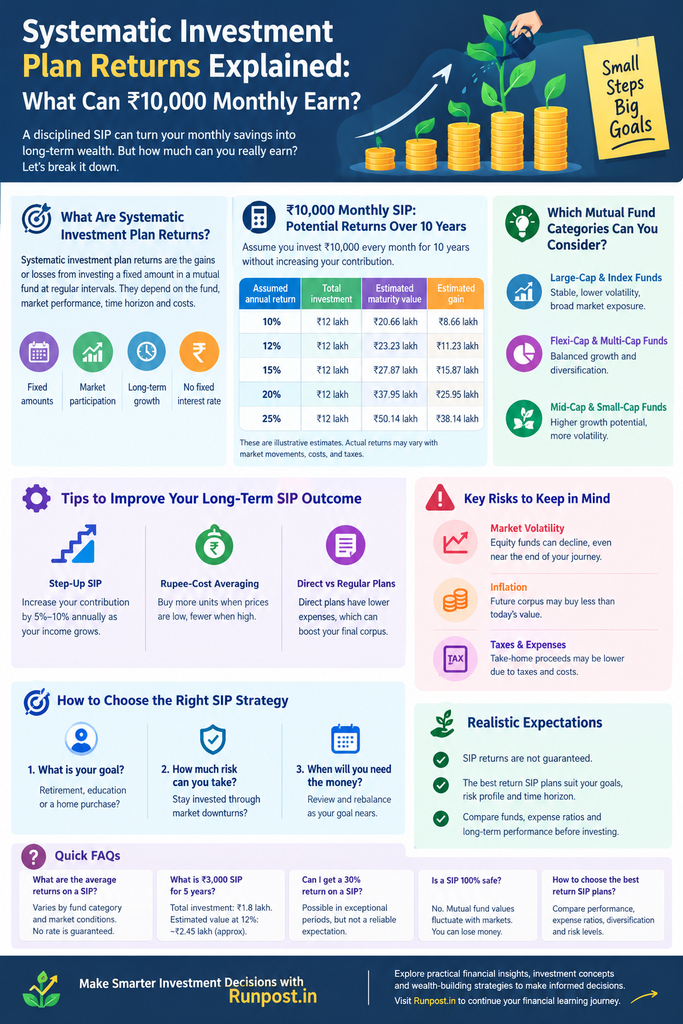
Note: Infographic explaining systematic investment plan returns on a ₹10,000 monthly SIP over 10 years, with projected maturity values, mutual fund categories, investment risks, and wealth-building strategies.
What Factors Can Improve Your Long-Term SIP Outcome?
Choosing a fund is only one part of investing successfully. Your contribution habits and ability to follow a suitable strategy through market cycles also matter.
Increase Contributions Through a Step-Up SIP
A step-up SIP increases your monthly investment periodically, often by 5%–10% annually. This can help you build a larger corpus as your income rises.
For example, you could begin with ₹10,000 per month and increase the contribution to ₹11,000 the following year with a 10% step-up. Your total investment would then exceed the ₹12 lakh contributed through a fixed SIP over the same decade.
The final corpus would depend on the timing of each contribution and the returns earned. Consequently, use a calculator that supports annual contribution increases when planning this strategy.
Understand Rupee-Cost Averaging
A fixed monthly investment buys more mutual fund units when the net asset value (NAV) is lower and fewer when it is higher. This is known as rupee-cost averaging.
According to the Association of Mutual Funds in India (AMFI), SIPs support disciplined investing and rupee-cost averaging. Regular contributions purchase more units when NAVs are lower and fewer when they are higher. However, this approach does not guarantee profits or protect investors from losses during declining markets.
Compare Direct and Regular Plans
Direct and regular plans of the same mutual fund scheme have different expense structures. Direct plans generally have lower expense ratios because they do not include distributor commissions.
Over a long investment period, even small differences in annual expenses can affect the final corpus. Compare the current expense ratio, services offered, and your need for professional advice before choosing a plan.
What Risks Should You Consider Before Investing?
- Market volatility: Equity funds can experience significant declines, including near the end of your investment period. A 10-year horizon does not eliminate the risk of losses.
- Inflation: A future corpus may buy less than the same amount today. When planning a goal, consider its expected future cost rather than focusing only on the nominal maturity value.
- Taxes and expenses: Your final proceeds may be lower than the estimated maturity value because of fund expenses and applicable taxes. Tax treatment depends on the mutual fund’s classification, the holding period of each investment, and the tax rules in force when you redeem your units. For equity-oriented mutual funds, review the latest guidance from the Income Tax Department.
Note: A fund with exceptional historical returns is not automatically the right choice for every investor. Compare schemes using their investment objectives, relevant benchmarks, costs, portfolio risks, and suitability for your financial goals rather than selecting one on returns alone.
How Can You Choose an SIP Strategy That Fits Your Goals?
Before investing, answer these three questions:
- What is your goal? Retirement, a child’s education, and a home purchase may require different investment timelines.
- How much risk can you tolerate? Consider whether you could stay invested during a substantial market decline without compromising essential financial needs.
- When will you need the money? As your goal approaches, review whether your allocation still matches your time horizon and whether reducing market exposure is appropriate.
Review your investments periodically against relevant benchmarks and your original objectives. Avoid unnecessary switching based on short-term performance alone.
For further research, compare fund expense ratios, investment mandates, risk disclosures, and long-term performance before selecting from the best return SIP plans available for your needs.
Make More Informed Investment Decisions with Runpost.in
Planning your financial future with systematic investment plan returns starts with understanding your options. Runpost.in helps readers explore investment concepts, mutual fund basics, and practical wealth-building strategies. Before committing to an SIP, compare potential returns, understand the risks, and align your investment choices with your financial goals. Explore Runpost.in for more financial insights to help you make informed decisions and build a disciplined approach to long-term investing.
Visit Runpost.in to continue your financial learning journey.

Conclusion
A ₹10,000 monthly SIP adds up to ₹12 lakh over 10 years, but its eventual value depends on market performance, investment costs, and contribution timing. Use realistic return assumptions, choose funds that match your risk tolerance, and review your portfolio periodically. Most importantly, remember that projected systematic investment plan returns are estimates, not guarantees.
Frequently Asked Questions
1. What Are the Average Returns on a SIP?
SIP returns vary by mutual fund category, market conditions, and investment period. There is no guaranteed average return. Compare historical performance with relevant benchmarks while considering costs and risks.
2. Can ₹10,000 Monthly Become ₹50 Lakh in 10 Years?
It could reach approximately ₹50 lakh under a sufficiently high assumed return. However, such an outcome is uncertain, and a 25% annual return should not be treated as a reliable planning assumption.
3. What Is the Value of a ₹3,000 Monthly SIP for 5 Years?
At an assumed nominal annual return of 12%, compounded monthly with end-of-month contributions, a ₹3,000 SIP could grow to approximately ₹2.45 lakh. Total contributions would be ₹1.8 lakh, excluding taxes and additional costs.
4. Can an SIP Deliver a 30% Return, and Is It Safe?
A 30% return may occur during exceptional market periods, but it is not dependable. SIPs in mutual funds are market-linked investments and do not guarantee returns or protect your principal.
5. How Can You Choose the Best Return SIP Plans?
Compare fund objectives, expense ratios, portfolio risks, Riskometer ratings, and performance against relevant benchmarks. Select investments according to your financial goals and risk tolerance rather than historical returns alone.
